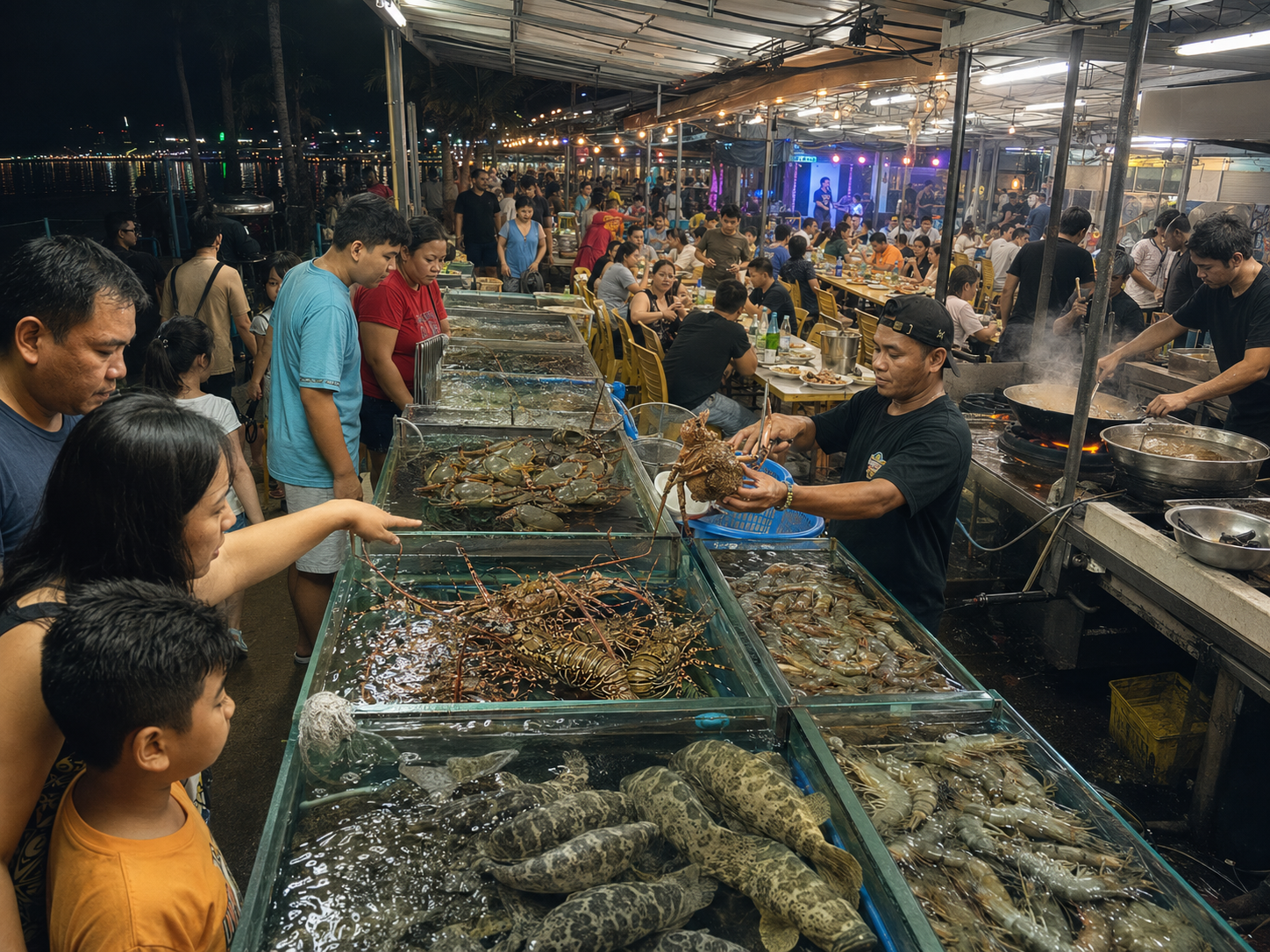
At the Seaside Dampa along Macapagal Boulevard in Pasay City, the air is thick with the smell of garlic butter and the shouts of tank-tappers. Families maneuver between rows of water-filled aquariums, pointing at live groupers, mud crabs, and spiny lobsters whose antennae thrash against glass. This is dampa — a distinctly Metro Manila experience where diners purchase fresh or live seafood from a wet market stall, then hand their haul to an adjacent restaurant that cooks it however they want. In a city where dining often means polished malls, dampa offers something far more primal.
The Dampa Ecosystem: Market Meets Kitchen
The concept thrives in several clusters: Macapagal Seaside, Farmer’s Market in Cubao, and the rebuilt Dampa sa Riverbanks in Marikina. At each, two types of vendors coexist: the palengke stalls selling seafood at competitive market prices, and the luto (cooking) restaurants that charge a service fee — typically PHP 150 to PHP 250 per dish — to steam, grill, fry, or boil your selections. Popular preparations include chili garlic crab, buttered prawns, and sinigang na ulo ng salmon (salmon head sour soup). At Aling Tonya’s Seaside Paluto, one of the veteran luto outlets, customers hand over a freshly bought kilo of sugpo (tiger prawns) and 15 minutes later receive a sizzling platter topped with toasted garlic and spring onions.
A Culinary Microcosm of the Philippines
Dampa dining is a mirror of the capital’s socioeconomic diversity. On weekend evenings, you will see groups of office workers pooling money for a celebratory crab feast, extended families marking birthdays with entire lapu-lapu (grouper) steamed in soy sauce and ginger, and even tourists guided by food bloggers seeking an “authentic” Manila experience. The Philippine Statistics Authority’s 2026 report on household food consumption indicated that seafood remains the fastest-growing protein source in Metro Manila, driven partly by the accessibility of markets like dampa (PSA Food Consumption Survey 2026). Urban dwellers increasingly view dampa not as a splurge but as a regular communal ritual.
Navigating Sustainability and Value
The dampa model, however, sits at a crossroads. A 2026 investigation by the Bureau of Fisheries and Aquatic Resources flagged concerns about undersized crabs and groupers appearing in some metro wet markets. In response, several dampa clusters have started voluntary labeling programs indicating catch origin and size compliance. Savvy diners now ask vendors for receipts showing the fish came from sustainable sources, a behavior shift driven by aggressive social media campaigns from groups like Oceana Philippines. Knowing what to avoid — gravid crabs, juvenile lobsters — has become part of the dampa etiquette.
The Future of Dampa in a Changing Metropolis
Land reclamation and commercial redevelopment constantly threaten the seaside dampa sites, but the format refuses to die. It has simply evolved. Online dampa delivery services now allow customers to order live seafood and cooking kits, replicating the experience at home. Despite this, the physical dampa remains irreplaceable: the hiss of water from a hose, the vendor untying a crab’s claws with practiced speed, and the communal table where strangers bond over the perfect garlic butter ratio. At Macapagal on a Saturday night, under fluorescent lights and with karaoke in the distance, you realize dampa is not just a meal — it is a living, breathing marketplace that distills Manila’s resourcefulness, appetite, and deep connection to the sea.