





![[Himala ng Niyebe at Cherry Blossoms] Isang natatanging karanasan sa taas na 1,900m: Maranasan ang “Snow Walls” at “Spring Snow Play” sa Otari Village, Nagano. May espesyal na operasyon sa maagang tagsibol hanggang Mayo 6; magbubukas ang Tsugaike Nature Park sa Hunyo 6.](https://buhaypinoy.ph/wp-content/uploads/2026/03/codeimg-13-150x150.jpg)

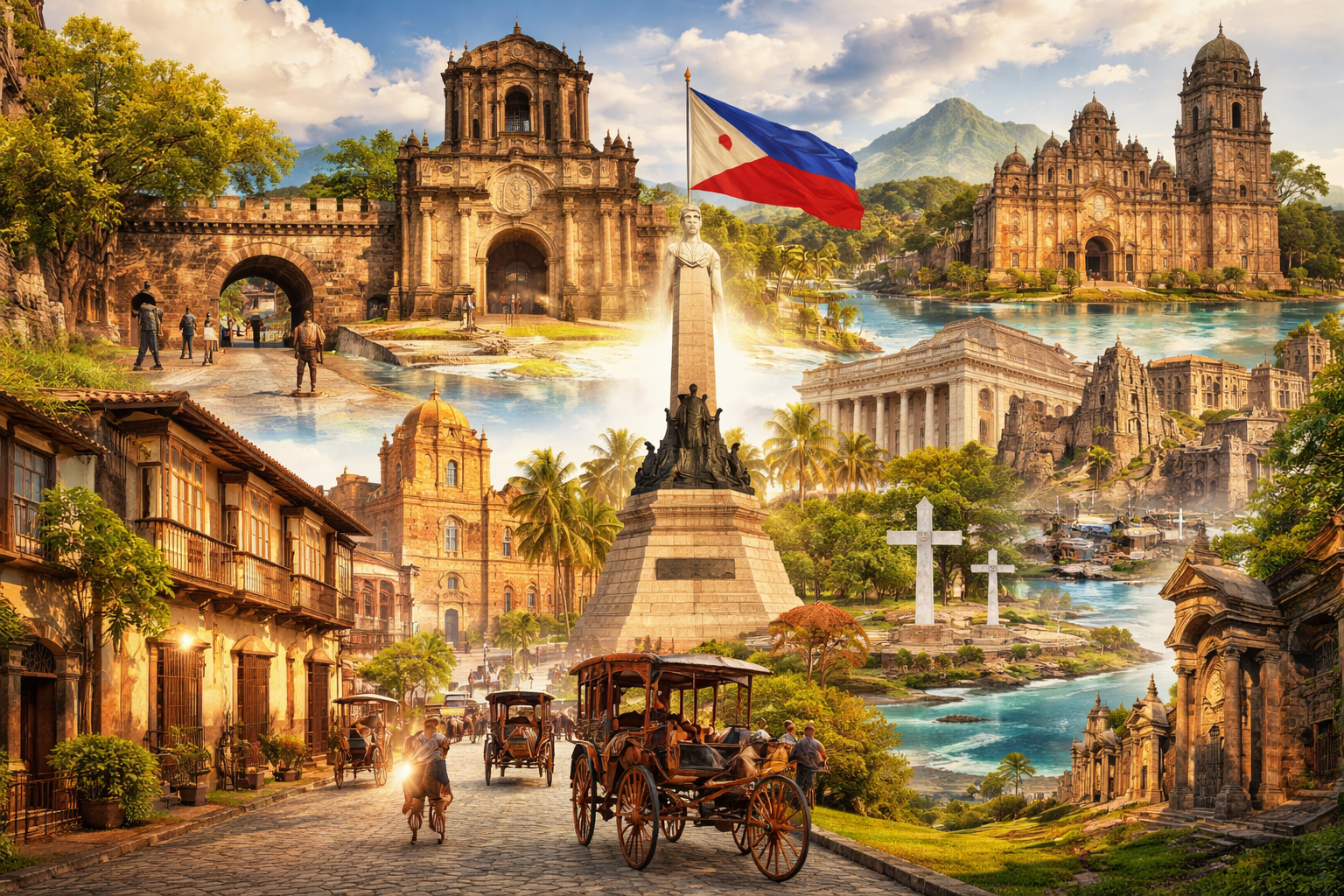
The Philippines is a remarkable destination for travelers interested in history because its heritage sites reveal how centuries of colonial rule shaped the country’s culture, religion, architecture, and public life. Unlike destinations where history is confined to museums, the Philippine past remains visible in old city walls, town plazas, stone churches, ancestral houses, and wartime landmarks. Spanish colonization defined much of the nation’s early urban and religious landscape, the American period introduced a new civic and educational order, and the Japanese occupation during World War II left powerful reminders of conflict and survival. Historical tourism in the Philippines therefore offers a broad and deeply human story rather than a narrow study of monuments.
A visit to Intramuros is often the best starting point for understanding this past. Established by the Spanish in Manila, it functioned as the political and ecclesiastical center of colonial authority. The district’s fortified walls and guarded gates reveal a society built on separation and control, where power was protected physically as well as socially. Within the area, travelers can explore cathedrals, administrative buildings, and defensive structures that once formed the core of empire in the islands. Fort Santiago is especially important because it represents several layers of history at once: military defense, colonial imprisonment, and nationalist remembrance. Its association with José Rizal gives it emotional significance beyond its architectural features, turning it into a place where visitors can connect the physical remains of empire with the birth of Filipino national consciousness.
Religious heritage is equally central to the experience of historical travel in the Philippines. During Spanish rule, missionaries played a major role in spreading Catholicism, often establishing churches as the center of new settlements. These buildings were not only spiritual institutions but also social anchors that influenced festivals, moral life, education, and community organization. San Agustin Church in Manila stands out as one of the oldest and most significant surviving churches, reflecting both artistic sophistication and historical endurance. In the provinces, the Baroque churches of Paoay, Miagao, Santa Maria, and Iloilo reveal how local builders adapted European forms using indigenous skills and available materials. Their heavy proportions, decorative façades, and protective design show how architecture responded to both natural disasters and social conditions.
For travelers who want to see how colonial society functioned outside the capital, Vigan provides a unique perspective. The city preserves a rare concentration of old houses and streets that show the domestic and commercial side of the colonial world. Here, visitors can observe how affluent families lived, how trade operated, and how local and foreign influences blended in everyday architecture. Vigan’s houses combine Spanish planning, Chinese commercial traditions, and Filipino climatic adaptations, making the city a valuable lesson in cultural exchange rather than simple colonial imitation. This complexity makes historical tourism more meaningful, because it shows that the past was shaped through negotiation as much as domination.
The American colonial period changed the built environment in noticeable ways. Public schools, government buildings, hospitals, and open civic spaces from this era reflect a program of institutional expansion and administrative modernization. The architectural style often shifted toward neoclassical forms, signaling order, rationality, and state power. By visiting these places, travelers can better understand how the American presence differed from the Spanish one, even though both were forms of foreign rule.
Another indispensable part of the Philippine historical experience involves wartime memory. Corregidor Island, memorials to the Battle of Manila, and cemeteries dedicated to soldiers and civilians preserve the pain of invasion and occupation. These sites remind visitors that the country’s history includes not only colonization but also fierce resistance and immense sacrifice. They give emotional depth to the travel experience and connect heritage with lived suffering.
Historical tourism in the Philippines offers a rare chance to trace the making of a nation through its surviving spaces. Every wall, church, ancestral house, and battlefield reflects a different chapter of foreign influence and Filipino response. Taken together, these places reveal a past that remains active in the country’s identity, traditions, and collective memory.