

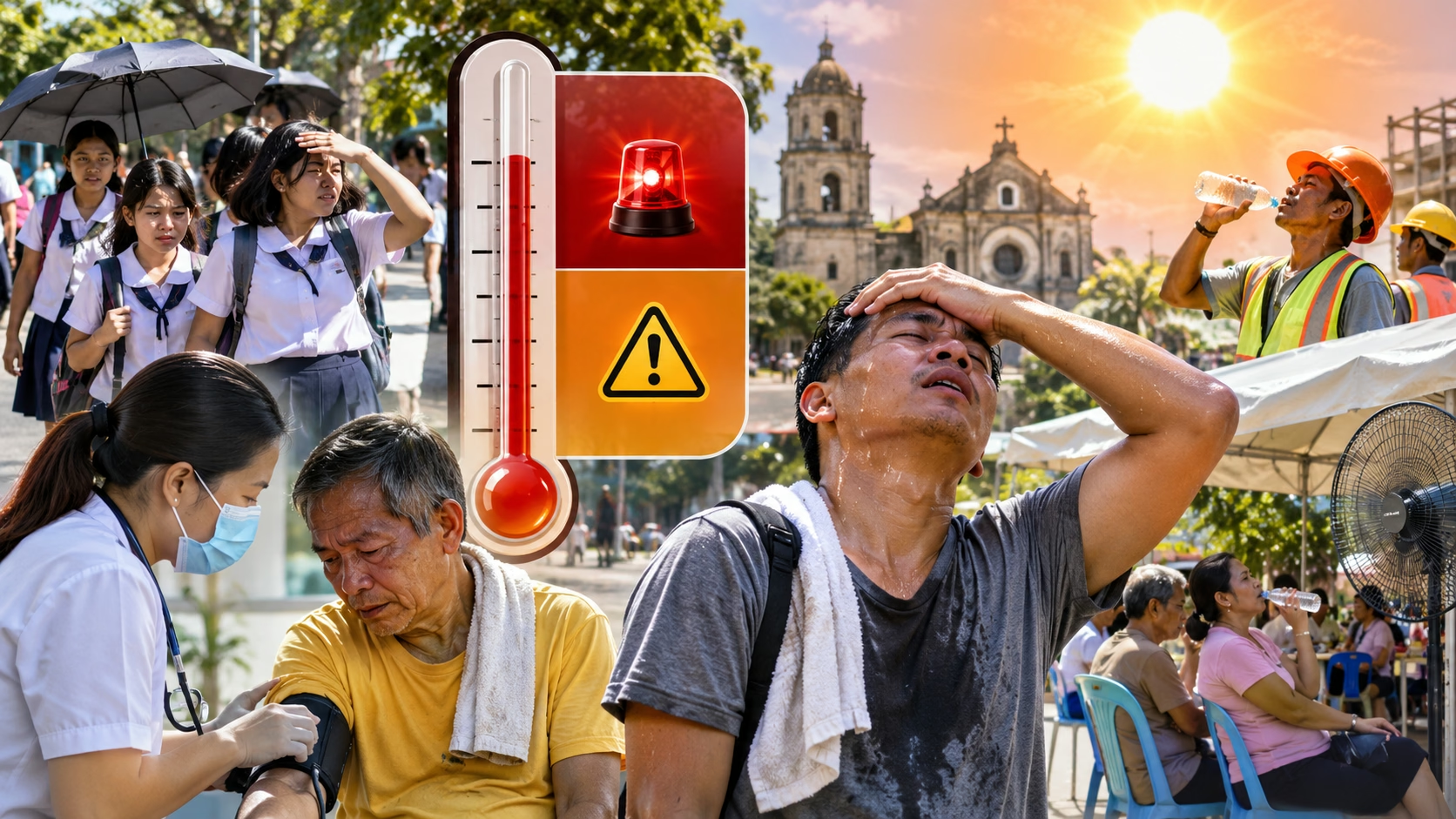
National heat warnings set the alert level. Local governments determine whether that alert becomes protection. In the Philippines, a growing number of cities are moving beyond seasonal advisories to build permanent heat response systems—cooling spaces, vulnerability mapping, and coordinated action plans—as El Niño drives heat indices deeper into the danger zone.
Iloilo City’s Cooling Hubs and the Shift From Advice to Infrastructure
In Iloilo City, residents have faced heat index levels reaching 47°C . For older persons, children, outdoor workers, low-income communities, and people with existing health conditions, that level of heat is not merely uncomfortable—it can become unsafe . With support from the United Nations Economic and Social Commission for Asia and the Pacific (ESCAP), the city has developed a heat-risk baseline assessment, an Urban Heat Action Plan, and pilot cooling hubs adapted from regional models .
The cooling hubs are linked to hydration support, public health assistance, communication campaigns, and urban greening . The project reflects a broader principle: heat resilience is not only a climate planning issue but also a public health, infrastructure, service delivery, and equity issue . Iloilo’s experience shows that regional knowledge exchange can translate into local action when cities have the mandate and partnerships to implement it.
Quezon City’s Heat Action Team
Quezon City has taken a different institutional route. In June 2026, the city government created a dedicated Heat Action Team (QC-HAT) to develop strategies, conduct vulnerability assessments, and recommend heat action policies to the City Council . Mayor Joy Belmonte described extreme heat as a “critical public health and safety emergency” that unfairly affects informal sector workers and outdoor laborers who lack cool, safe housing and immediate health services .
Quezon City recorded heat indices averaging between 42°C and 44°C in 2024 and 2025, squarely within PAGASA’s danger category . The QC-HAT is intended to move the city from reactive class suspensions to a comprehensive plan that addresses cooling, health services, and vulnerable populations in a coordinated way .
The Unfinished Work of Heat Governance
Local innovation is advancing faster than national systems in some respects. A 2026 case study of the Philippines’ heat early warning system found that PAGASA operates a national Heat Index-based monitoring system through the iHeatMap and dry-season advisories, but thresholds are not yet fully calibrated to local impacts, and heat risk can extend beyond the seasonal monitoring window . Preparedness measures remain fragmented across sectors rather than unified under a national Heat Action Plan, and heat is not yet fully embedded as a core hazard in the disaster risk reduction system .
The implication is clear: cities such as Iloilo and Quezon City are filling a gap that national policy has not yet closed. Their cooling hubs and heat action teams offer practical models, but scaling them to every vulnerable community will require sustained financing, local data, and a recognition that heat is a health emergency, not merely a weather inconvenience.