
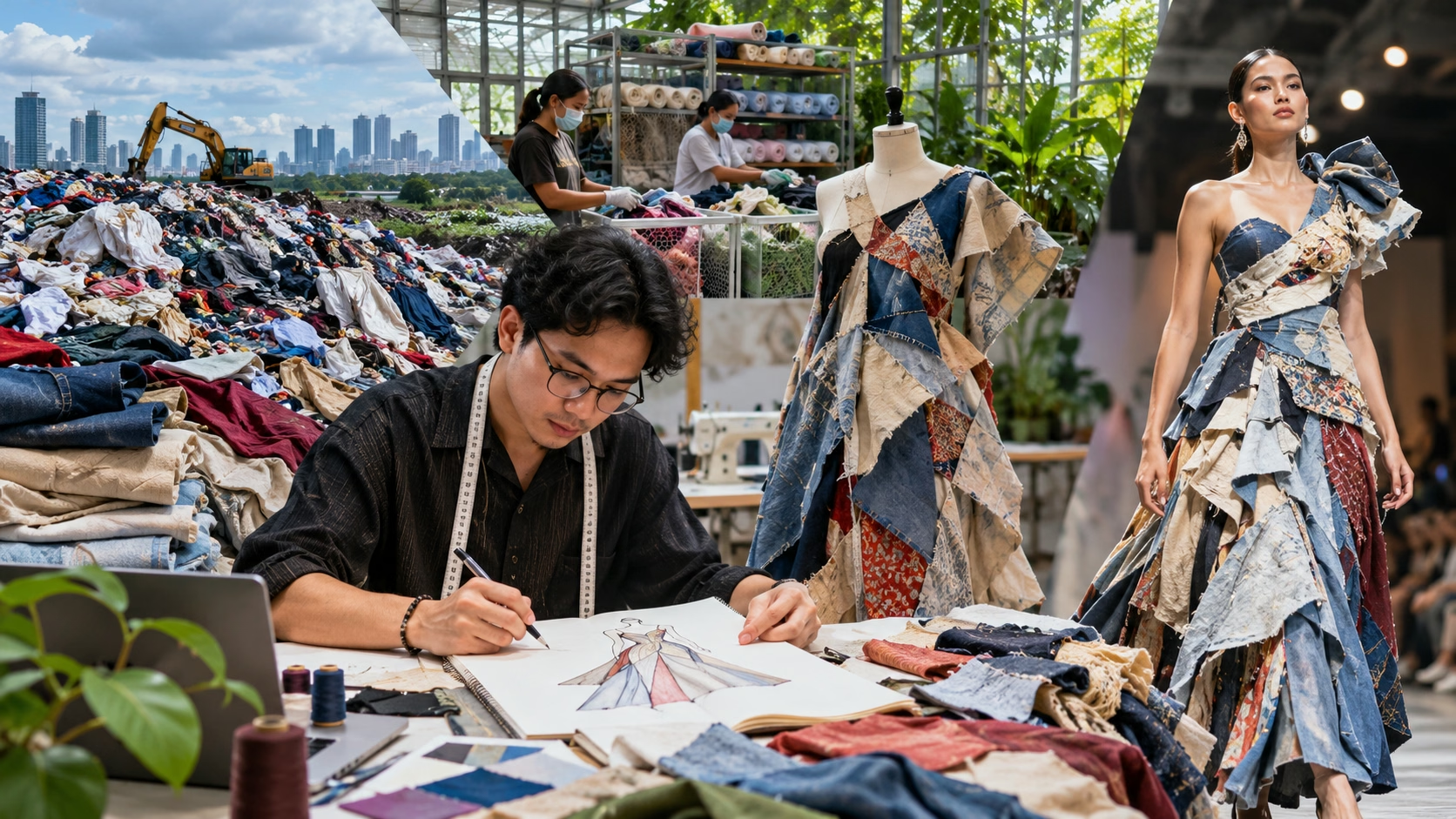
From Rag Picking to Runway
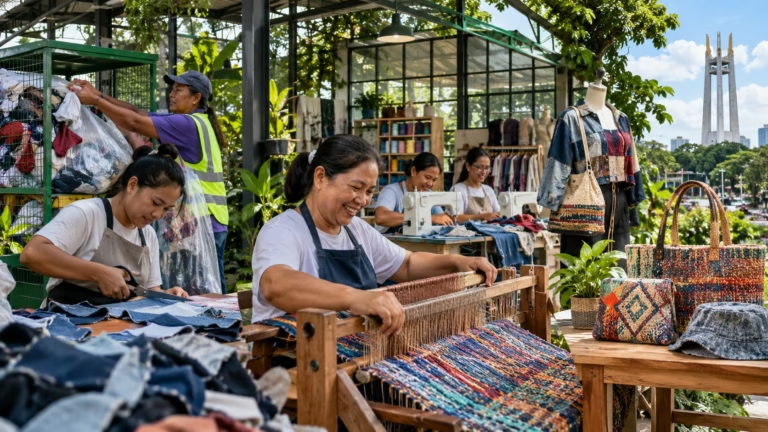
The story of deadstock fashion in the Philippines cannot be told through designers alone. Some of the most durable models have been built by social enterprises that treat upcycled fabric as both a commercial material and a livelihood intervention. The starting point is often the same: communities near dumpsites and waste facilities where women have historically recovered fabric scraps and woven them into low-margin rags, mats, and floor coverings. The intervention is not charity. It is market repositioning—moving the same labor and material into product categories with higher retail value.
R2R, which began as Rags2Riches, is the clearest long-running example. Founded in 2007 by Reese Fernandez-Ruiz and co-founders who had visited Payatas as college students, the enterprise partnered with women artisans to produce eco-ethical fashion and home accessories from upcycled, overstock fabrics and local textiles. Instead of artisans selling basahans on the street, R2R connected them directly to garment factories and warehouses for material sourcing, established retail and online channels, and collaborated with established designers such as Rajo Laurel and Amina Aranaz-Alunan to create high-fashion pieces from the women’s weaves.
R2R and the Branding of Upcycled Fabric
The critical move was branding. R2R did not present its products as charity goods or generic eco-merchandise. It built a brand around handmade quality, artisan skill, and material storytelling, registered its trademarks with the Intellectual Property Office of the Philippines, and positioned its output in the same retail spaces as conventional fashion accessories. The result was higher and more stable earnings for artisans, not through subsidy but through price repositioning in the market.
The commercial logic is instructive for the broader deadstock sector: upcycled fabric does not automatically command a premium. The material carries a sustainability narrative, but that narrative must be translated into product quality, design coherence, and brand trust. R2R’s experience suggests that the branding function—not the sewing function—is the primary determinant of whether deadstock becomes a high-value product or remains a low-margin craft.
And Again Clothing’s Flour Sack Revolution
A newer enterprise demonstrates the same principle with a different material stream. And Again Clothing, a Manila-based slow-fashion brand founded by Hazel Roldan in 2019, transforms discarded industrial flour sacks into modern garments including polos, skirts, and pants. The material—katsa, a coarse, unbleached plain-weave cotton—has long been reused in Filipino households as cloth diapers and cleaning rags. And Again’s innovation is to treat it with the same design intentionality as premium fabric, approaching print placement, silhouette, and pattern with the rigor of a high-end line.
The operational model is equally deliberate. In 2025 alone, And Again upcycled 300 kilograms of textile waste—approximately 2,000 sacks—with plans to reach 350 kilograms by 2026. Roughly 90 percent of each flour sack is incorporated into the main garment, with clean scraps retained for smaller applications. The brand provides fair, dignified livelihoods for local women artisans and working students, linking material circularity directly to decent work outcomes.
The Livelihood Multiplier of Deadstock Fashion
The social-enterprise model reveals a dimension of deadstock fashion that designer-led collections often understate: labor intensity as an asset. Upcycling is not a highly automated process. Sorting, cleaning, cutting, sewing, and finishing require hands—many hands. In a country with a large informal textile workforce, that labor intensity is not a cost problem to be engineered away. It is the mechanism through which material value is converted into household income and community enterprise.
The remaining challenge is market access. Social enterprises can produce high-value upcycled goods, but they must compete for shelf space and consumer attention against brands with larger marketing budgets. The enterprises that succeed are those that build hybrid identities—part fashion brand, part impact enterprise—and that can document the material and livelihood story without reducing the product to a cause. When that balance is achieved, deadstock fabric becomes more than a waste solution. It becomes a repeatable input for a distributed, artisan-based luxury economy.