
Sustainability Is Not a Differentiator—It’s the Entry Ticket
In the premium international resortwear segment, a brand that cannot articulate its material provenance and end-of-life strategy is increasingly excluded from buyer conversations. European and Japanese retailers face mounting regulatory pressure and consumer scrutiny around textile waste and supply chain transparency. The question is no longer whether a brand is sustainable, but whether its sustainability claims are verifiable and embedded in production rather than appended in marketing copy.
Filipino resortwear brands that have invested in circular infrastructure are discovering that this constraint has become an advantage. The country’s long tradition of repurposing—described by Quezon City Mayor Joy Belmonte as something “Filipinos have always done long before sustainability became a global trend”—provides a cultural foundation that newer markets lack .
TexRev: The Science of Textile Circularity
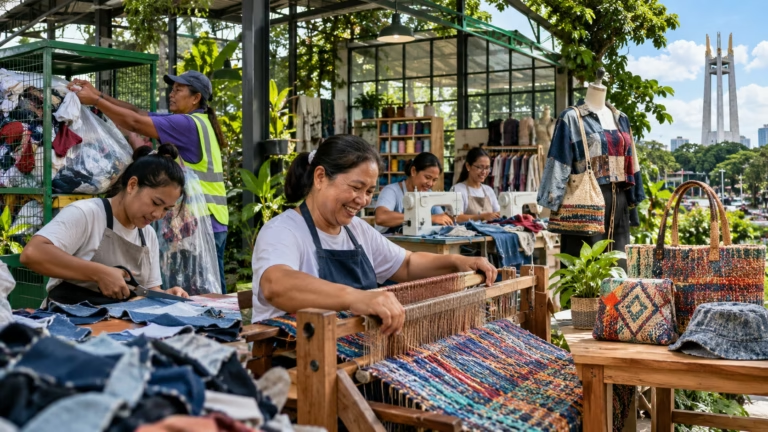
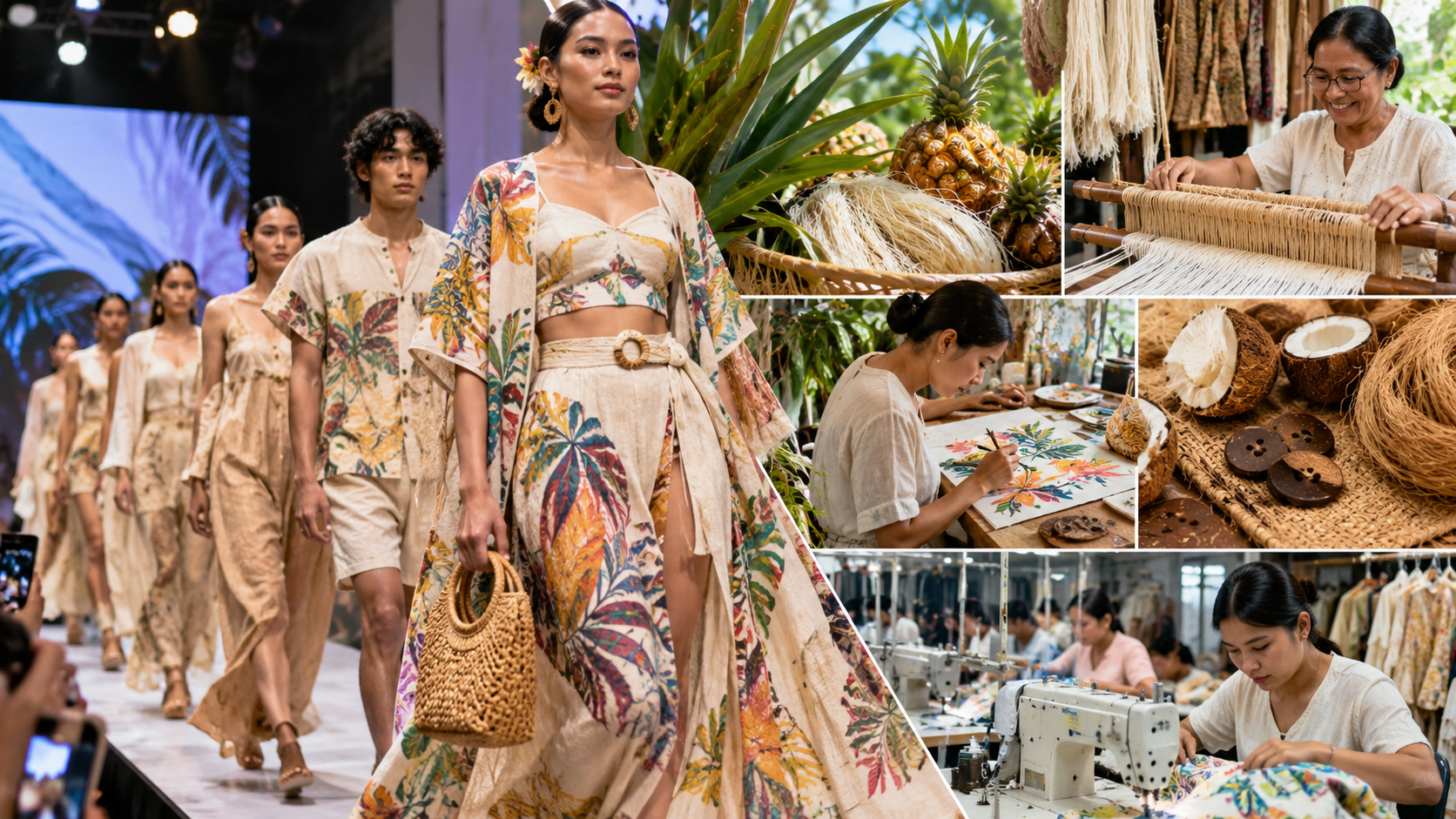
The most substantive circular initiative in the Philippine fashion sector is the TexRev project, a collaboration between Bayo Manila and the Department of Science and Technology’s Philippine Textile Research Institute (DOST-PTRI). Launched at the National Textile Convention in January 2025, TexRev converts post-industrial textile waste into spinnable yarns through a process of color and material sorting, shredding, carding, impurity removal, and blending with virgin fibers .
Bayo, which produces approximately 16 tons of textile waste annually, serves as the primary industry partner, providing feedback on yarn quality and applicability . The resulting yarns are designed for both machine and handloom processes, making them suitable for the small-batch, artisanal production models that characterize premium Filipino resortwear. The repurposed yarns flow to Bayo Foundation’s Harvest hubs, where community artisans produce handwoven textiles .
For resortwear brands seeking premium positioning, TexRev offers something more valuable than a sustainability certificate: a domestic supply of traceable, circular yarn that reduces dependence on imported virgin fibers—the sector’s most persistent structural weakness .
Zero-Waste Design as Brand DNA
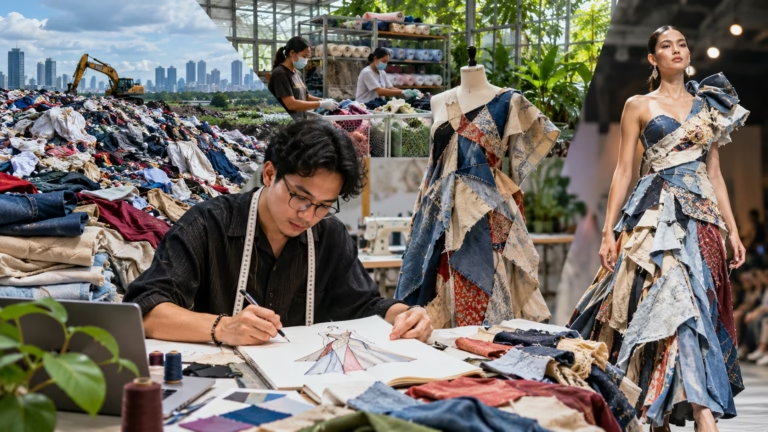
At the product level, circularity takes different forms. Alta Bella, the Filipino-owned Macao brand that exhibited at CENTRESTAGE 2025, built its resortwear collection around zero-waste pattern-cutting techniques and recycled materials . This is not a seasonal capsule strategy. The brand’s identity is constructed around the premise that luxury and waste reduction are compatible—even mutually reinforcing.
The aesthetic implications are significant. Zero-waste design constrains pattern shapes, often producing garments with geometric construction and minimal offcuts. For resortwear, where relaxed silhouettes and simple shapes are natural fits, this constraint aligns well with the product category. The resulting garments carry a subtle visual signature—slightly more structured, slightly more deliberate—that differentiates them from conventionally cut beachwear.
The Artisan Circularity Model
A third circular model operates at the community level. Orias’s “Punto de Vista” collection integrates handmade crochet produced by single mothers in Valenzuela and a Marikina student artist into garments that layer these elements against lace and coated fabric . The circularity here is social rather than material: the brand creates economic participation for marginalized producers while incorporating their craft into premium products.
This model carries its own risks. Artisan-dependent production is difficult to scale, quality varies, and lead times are unpredictable. But for a resortwear brand positioned at the ultra-premium end—where scarcity and narrative justify higher price points—these “limitations” become part of the value proposition. A garment that takes three weeks to produce because it incorporates hand-crocheted elements is not a supply chain failure. It is a luxury signal.
The Remaining Gap: Policy and Infrastructure
The circular economy infrastructure supporting Filipino resortwear remains fragmented. TexRev has one anchor industry partner. The Taytay garment cluster’s strategic planning process, initiated in April 2026, identified “Source of Materials” and “Technology and Digitalization” as priority areas but has yet to produce coordinated action . Individual brands are building circular supply chains in isolation, without shared collection systems, sorting facilities, or quality standards.
For the premium international market, this fragmentation is manageable at small volumes. A brand producing 500 units per season can trace its TexRev yarn from collection point to finished garment. Scaling to 5,000 units—the minimum for meaningful department store placement—requires infrastructure that does not yet exist at national scale.
The opportunity is clear. The question is whether the sector can build collective systems fast enough to meet the premium market’s growing demand for verifiable circularity, before that demand shifts to competitors in Vietnam, India, or Turkey who are already investing at scale.