
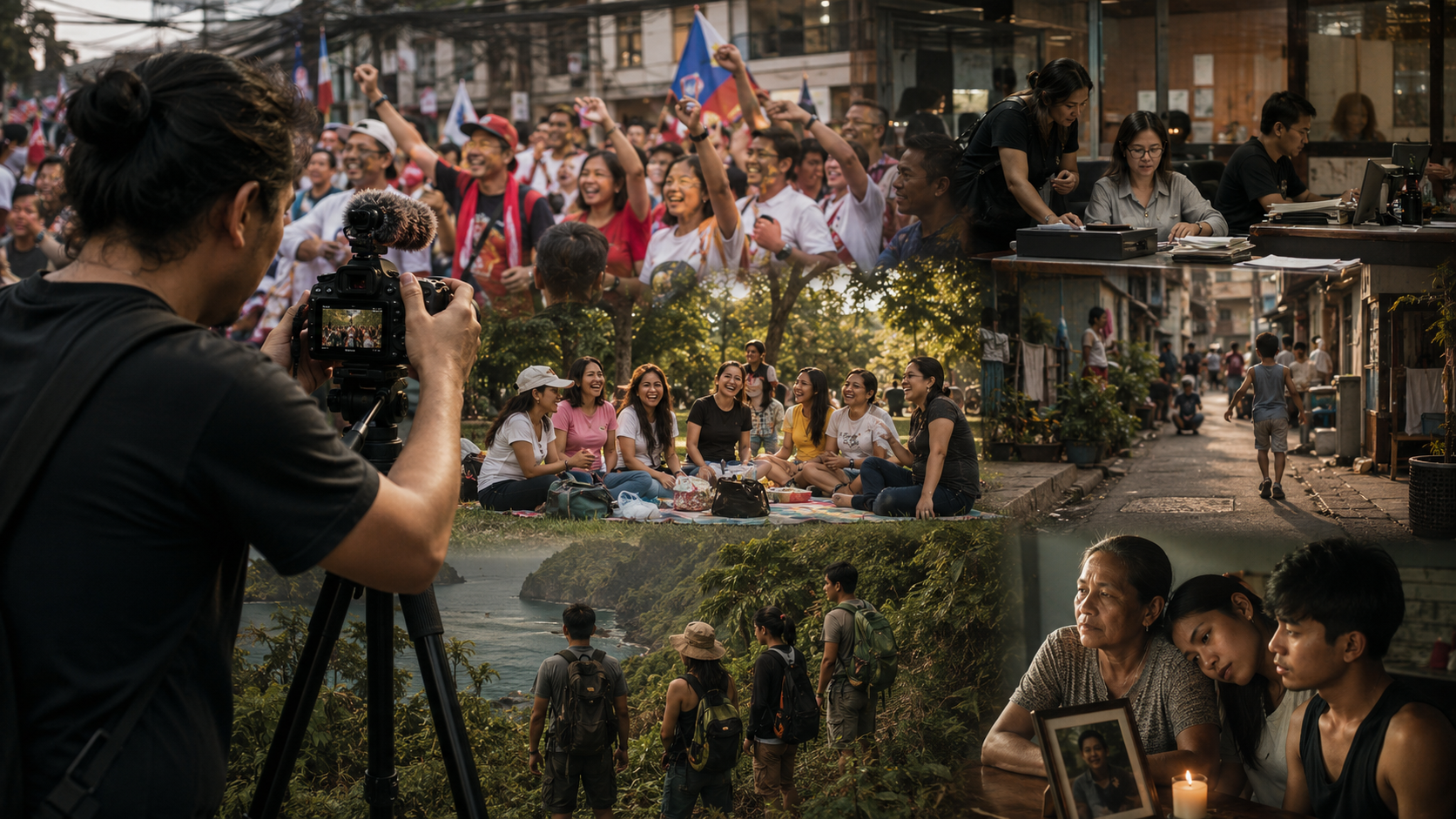
Philippine documentaries offer one of the most varied nonfiction portraits of a modern Southeast Asian nation. Their stories move from election rallies and newsrooms to migrant communities, threatened forests, urban neighborhoods, and families waiting for missing relatives to return.
This wide field of subjects is more than a sign of creative experimentation. It reflects a country where geography, language, class, politics, and historical memory produce sharply different experiences of the same national events.
For that reason, Philippine documentary cinema is often strongest when it avoids claiming to present one complete truth. Instead, filmmakers record voices that complicate the official picture.
Democracy Seen From the Ground
Political documentaries are a highly visible part of this tradition.
Ramona S. Díaz’s And So It Begins examines the atmosphere of the 2022 Philippine presidential race. After premiering at the 2024 Sundance Film Festival, the documentary became part of a wider international discussion about democracy, campaigning, political identity, and the information environment surrounding elections.
Díaz’s earlier documentary A Thousand Cuts focuses on journalist Maria Ressa and the pressures surrounding press freedom. Seen together, the films show how democratic systems are experienced by real people rather than existing only as constitutional ideas.
JL Burgos’s Alipato at Muog approaches political history through an unresolved family story. The documentary investigates the disappearance of activist Jonas Burgos in 2007. Its classification dispute in 2024 created fresh public discussion about censorship and the limits placed on films dealing with politically sensitive events.
Such cases reveal an important role of nonfiction cinema: a documentary can keep a question alive long after the news cycle has moved on.
Migration Beyond Statistics and Stereotypes
Other Filipino documentaries broaden the national story by following people living outside the country.
Baby Ruth Villarama’s Sunday Beauty Queen centers on Filipino domestic workers in Hong Kong. On their days off, the women organize beauty pageants and build a temporary space for celebration and self-expression.
The film transforms the familiar public image of the overseas Filipino worker. Instead of focusing only on sacrifice or remittances, it reveals humor, friendship, creativity, pressure, and individual dreams.
This human-centered approach is central to the diversity of Philippine documentary storytelling. Social issues become more understandable when viewers see how they shape a person’s daily routine.
Defending Communities and Natural Resources
Environmental films offer another important branch of Philippine nonfiction cinema.
In Delikado, filmmaker Karl Malakunas follows land and environmental defenders in Palawan as they oppose illegal logging. The documentary shows that environmental protection is not simply a scientific or conservation issue. It is also connected to political power, economic interests, local governance, and physical danger.
Alyx Ayn Arumpac’s Aswang examines a different crisis: the human impact of the Philippine drug war. By focusing on communities living with violence and uncertainty, the documentary challenges audiences to look beyond government figures and policy language.
These films turn broad national issues into experiences that can be seen, heard, and remembered.
One Hundred Years of Recording Reality
The current generation of filmmakers is part of a documentary history stretching back roughly a century.
The Daang Dokyu initiative was developed to recognize 100 years of Philippine documentary filmmaking and to bring works from different periods into public discussion. Its programs have helped frame nonfiction cinema as an important historical record rather than a minor category within the film industry. More information is available through Daang Dokyu.
Modern filmmakers benefit from digital technology and wider international festival networks, but significant obstacles remain. Funding is limited, documentary distribution can be difficult, archives require long-term support, and politically sensitive work may face institutional pressure.
Yet these challenges also explain why documentary diversity matters. Each preserved testimony expands the public record. Each local story challenges a simplified national image.
Taken together, Philippine documentaries do not offer one final definition of the country. They offer something more valuable: a living collection of arguments, memories, conflicts, and human experiences that continue to reshape how the Philippines understands itself.