

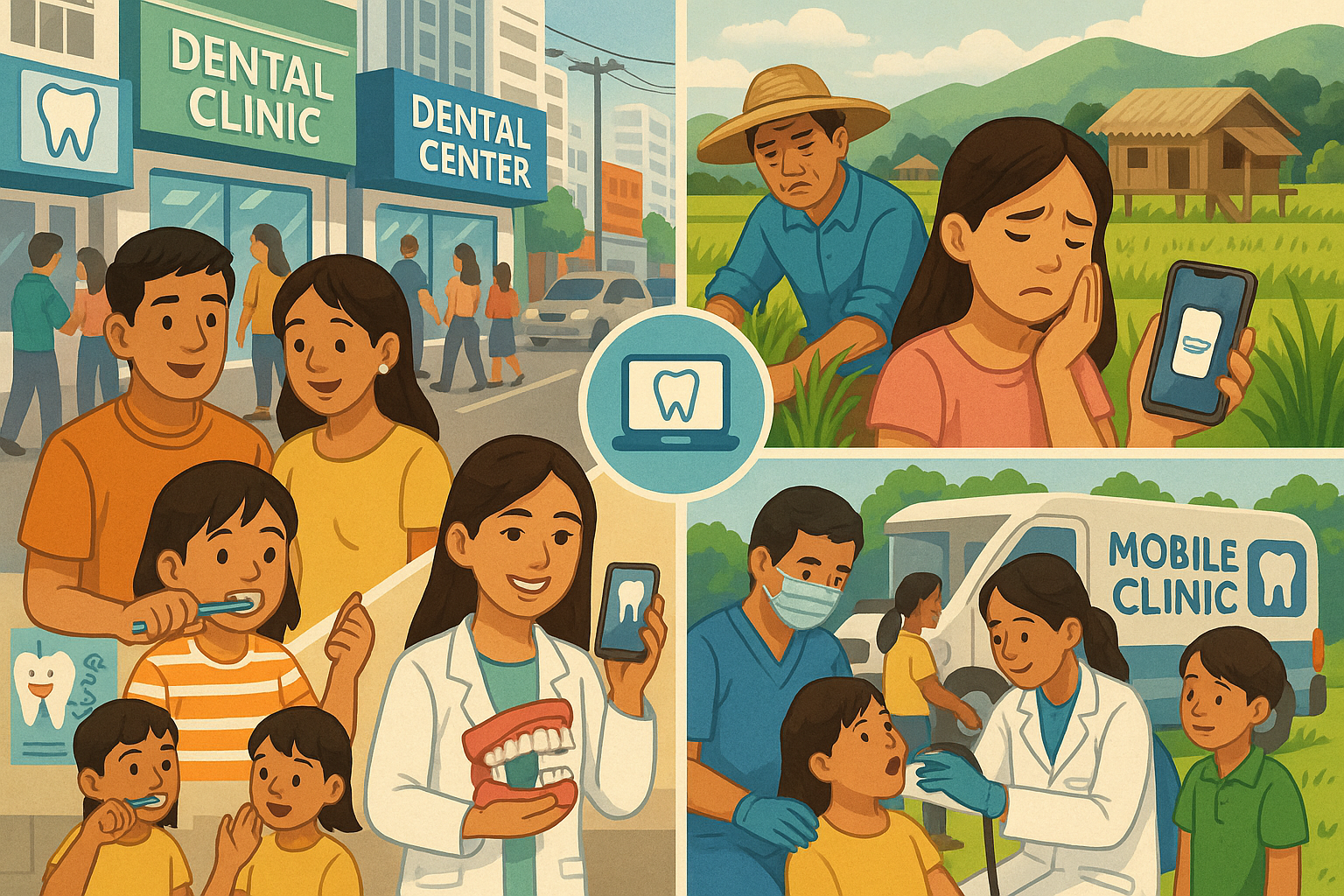
Understanding dental health care in the Philippines means looking closely at everyday experiences. Imagine a family in Manila, where dental clinics are visible along busy streets. They can choose between a neighborhood clinic and a larger dental center inside a mall. Prices vary, and they might compare options, ask friends for recommendations, or look up reviews online. Even if cost is a concern, services are at least physically accessible.
Now compare this with a family in a remote province. The nearest dentist may be several towns away, with limited transportation options and unpredictable travel times. Planning a dental visit becomes a logistical challenge, competing with farm work, childcare, and other responsibilities. In this setting, a mild toothache is often tolerated until it becomes unbearable, by which time treatment options may be more invasive.
These contrasting situations highlight how geography and infrastructure shape access to dental care. Urban residents benefit from a concentration of private and public facilities, while rural communities struggle with scarcity of professionals and equipment. Government health centers may provide basic services, but they are not always regularly staffed with dentists. This uneven distribution contributes to persistent differences in oral health status across regions.
Awareness is gradually shifting, especially among younger generations. Social media platforms, influencers, and online health content have made topics like braces, whitening, and smile aesthetics more visible. Many young Filipinos now see dental appearance as part of self-expression and confidence. This trend can motivate more frequent clinic visits, but it also risks focusing attention on cosmetic improvements rather than foundational habits like proper brushing, flossing, and regular check-ups.
Schools and community programs serve as important bridges between information and practice. Tooth-brushing campaigns, educational posters, and classroom talks help children understand why they need to care for their teeth. When teachers model good habits and parents reinforce them at home, behavior change becomes more sustainable. However, these initiatives require materials, training, and continued support to avoid becoming one-time events that quickly fade from memory.
The cost of care remains a central barrier. Even when people understand the importance of oral health, they may not have the financial capacity to act on that knowledge. Public insurance offers some relief, primarily for basic treatments, but many procedures still require direct payment. Filipinos often prioritize food, housing, and schooling over preventive dental visits, which are seen as optional until pain or infection forces immediate action.
Despite these challenges, there are encouraging developments. Dental associations, universities, and non-governmental organizations frequently organize outreach activities, bringing free or low-cost services to underserved communities. Mobile clinics can reach schools and barangays that rarely see a dentist. These programs also provide an opportunity for health education, emphasizing daily care and early treatment.
Technological advances open new possibilities as well. While still emerging, teleconsultation and online booking systems can help patients connect with dentists, ask initial questions, and receive guidance about when in-person treatment is necessary. For urban and semi-urban areas with stable internet access, these tools can reduce uncertainty and make care feel more approachable.
In the long term, improving dental health in the Philippines means more than increasing the number of clinics. It requires building a culture where oral health is valued, where people understand that a healthy mouth affects nutrition, speech, social interaction, and overall well-being. By addressing cost, access, and awareness together, the country can move toward a future in which healthy teeth are not a privilege for the few, but an achievable goal for everyone.